
Nordic Assistant
PART 3: Creating a Campaign
How I Reached 9,000 Ideal Visitors Using Only €2 per Day
Why Visibility is Key
Being a great consultant isn’t enough – your future clients need to know you exist. In this module, I’ll show you how I attracted 9,000+ highly targeted visitors to my offer with a simple Facebook campaign on a shoestring budget. By the end, you’ll see why Facebook/Instagram was my channel of choice (over Google Ads or LinkedIn) and how you can replicate this cost-effective strategy for your own business.
Step 1: Choose the Right Platform (Why Facebook/Instagram Beats Google & LinkedIn)
Why I Chose Facebook/Instagram for B2B
Many consultants default to running ads on Google or LinkedIn. I chose Facebook (and Instagram) for one big reason: precision and efficiency. Simply put, Facebook’s ad platform offers unique advantages for reaching a niche B2B audience on a small budget:
- Detailed Targeting: You can target people by job title, industry, company size, interests, behaviors, and more. This level of granularity let me pinpoint exactly the decision-makers I wanted to reach.
- Global Reach: Facebook/Instagram’s massive user base means even a niche audience can be reached worldwide. My consulting offer is niche but global, and Facebook allowed me to find prospects in over 30 countries with ease. (For perspective, Facebook has over 3 billion monthly users worldwide tekrevol.com.)
- Low Cost: Facebook Ads have a low cost-per-thousand impressions (CPM) and cost-per-click compared to other platforms. Even with a €2/day budget, my ads were shown to thousands of the right people. LinkedIn, by contrast, can charge 5–10× more per click tripledart.com, making it tough to sustain on a small budget.
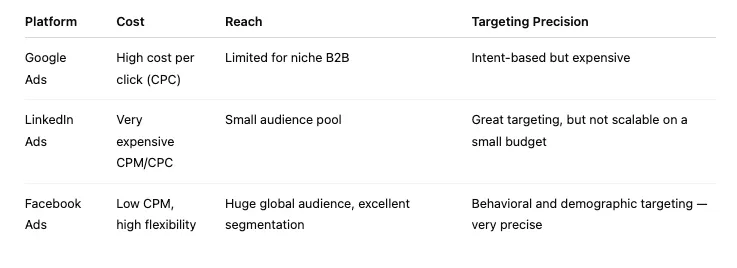
Platform Comparison
This table highlights why I chose Facebook/Instagram as my main ad channel. LinkedIn ads are known to be expensive (often $5–$10 per click tripledart.com) with a limited audience size, and Google Ads depend on users actively searching (plus they can be costly). Facebook/Instagram ads, on the other hand, offer low-cost impressions to a huge audience (over 3 billion users tekrevol.com) and incredibly precise targeting based on demographics and behavior. It lets you reach your ideal clients where they spend their time – scrolling social media – not just when they happen to search.
In short: Google Ads are effective for intent-based searches but often pricey (and some of that search traffic is now shifting to AI tools). LinkedIn can directly target professionals but at a high cost per click. Facebook/Instagram strikes the best balance for my needs – it’s cost-effective and lets me proactively put my message in front of exactly the right people, before they go looking for solutions.
Hooking Up Your Facebook Business Page
Set Up Your Facebook Business Page
Before launching ads, you’ll need a Facebook Business Page (this also enables Instagram ads since they run on Facebook’s platform). Setting up a page is free and straightforward, but essential for running a professional campaign. Here’s how to create your page step-by-step:
- Create a New Page: In your Facebook account menu, go to “Pages” and click “Create New Page”.
- Name & Category: Enter your page name (usually your business or brand name) and choose a category that best describes your business.
- Bio: Write a short description or bio that clearly states what you do and who you help. Then click Create.
- Details: (Optional) Add additional info like contact details, location, business hours, etc., then click Next.
- Visuals: (Optional) Upload a profile photo and cover image that represent your brand (logo, team photo, or a relevant graphic). You can also set a call-to-action button (e.g. “Book Now”, “Learn More”) on your page. Click Next when done.
- Invite Followers: (Optional) Facebook will prompt you to invite friends or contacts to follow your new page. This can help get some initial visibility – go ahead and invite anyone who might be interested, then click Next.
- Publish: Finally, review your details and click Done. Your Facebook page is now live! You’re officially open for business on social media.
With your page ready, you have a foundation to run ads and also a place where prospects can check out your info, posts, and contact you. It builds trust to have a well-filled-out page behind your ads.
Step 2: Define Your Audience (with a Little Help from AI)
Define Your Ideal Audience with AI
A successful campaign needs a clearly defined target audience. Rather than guess, I used ChatGPT as a brainstorming partner to map out my ideal customer profile for this campaign. We identified key segments in several dimensions:
- Industries: e.g. B2B Sales, Infrastructure, Renewable Energy, Construction, Industrial Tech, International Business (areas where companies might expand to Sweden).
- Job Roles: e.g. CEO, Business Development Manager, Project Manager, Export Manager, Head of Procurement – roles with decision-making power in market expansion.
- Company Sizes: Ranging from Small (10–200) and Medium (200–500) up to Large (500+ employees). I suspected that mid-sized companies might be most interested, but I included a broad range to test responsiveness.
- Behaviors & Traits: For example, people who are international travelers, involved in B2B buying, or those who have shown interest in "market entry" or "business expansion" services. These clues help target those already inclined towards global business.
- Geographic Markets: I brainstormed countries where Sweden often partners or where interest in Nordic expansion is high. I ended up with a list of over 30 countries – including the USA, Germany, the Netherlands, Japan, Israel, Canada, Singapore, and more – covering North America, Europe, and parts of Asia.
This research gave me a potential audience size of roughly 150 million people across all these countries. That’s very broad, but Facebook’s algorithm can optimize delivery within that, and I’d rather cast a wide net initially to see which pockets respond best. (As it turned out, I got clear insights into which regions and profiles engaged most, which helped me refine the campaign over time.)
Why use AI for this? Tools like ChatGPT are great for generating a list of target attributes you might not immediately think of. It’s like having a marketing assistant to ensure you don’t miss any obvious segment. By feeding it details about my service, I got suggestions for industries and roles to target that aligned with my offer. This helped ensure my Facebook targeting leveraged all relevant parameters available.
Step 3: Create the Campaign (Ad Content & Launch)
Create a Facebook Ad Campaign: My Process
With my audience defined, I moved on to creating the Facebook ad campaign itself. First, I set up the basics on Facebook’s Ads Manager (accessible directly through my Facebook Page via the “Advertise” button). My campaign was configured as follows:
- Campaign Objective: Traffic – I wanted to drive visitors to my landing page (where they could get my Lead Magnet and learn more). On Facebook, I chose “Get more website visitors” as the goal.
- Ad Format: A short video ad (~60 seconds) explaining my offer and inviting clicks. Video tends to catch attention more than a static image and allows me to convey credibility and value quickly.
- Ad Creative (Content): I scripted the video using ChatGPT (leveraging AI again to draft a compelling narrative) and then produced the video using an AI video tool. The video had an English voice-over and captions, making it accessible and professional without a big production budget.
- Budget: I set the daily budget to €2 (the minimum in many cases). This might sound tiny, but as you’ll see, it was enough to reach ~100 new people a day in my target group – plenty to gather data and generate leads initially.
- Duration: I let the campaign run continuously for ~3 months (90 days), monitoring results and tweaking if needed, but largely letting Facebook’s algorithm do its thing.
The video ad content was carefully crafted to hit key points in one minute. It covered:
- Hook: An attention-grabber about the challenges of entering a new market (to resonate with my audience’s pain point). For example, I opened with a question like: “Expanding to a new country and not sure where to start?” – something to make my target viewers stop and think.
- Credibility: A quick intro of who I am (mentioning my 20 years of experience, etc.) to build trust. I made sure viewers knew I have real expertise in market entry for Sweden.
- Solution Offer: I presented AI Jarl (my digital guide subscription) combined with my personal consulting as the solution to their problem, highlighting how it addresses the challenges mentioned in the hook.
- Call to Action: A clear instruction – e.g., “Visit my site to get your free guide on expanding to Sweden” – encouraging them to click the ad right then.
This concise structure ensured the ad was relevant and enticing. And it worked – the click-through rate (CTR) on the video ad ranged from 3% up to 36%, depending on the region, which is quite good for cold traffic. (Certain markets with less competition or a greater affinity for the offer saw very high CTR, showing the message really resonated there.)
Create a Facebook Ad Campaign: My Process
With my audience defined, I moved on to creating the Facebook ad campaign itself. First, I set up the basics on Facebook’s Ads Manager (accessible directly through my Facebook Page via the “Advertise” button). My campaign was configured as follows:
- Campaign Objective: Traffic – I wanted to drive visitors to my landing page (where they could get my Lead Magnet and learn more). On Facebook, I chose “Get more website visitors” as the goal.
- Ad Format: A short video ad (~60 seconds) explaining my offer and inviting clicks. Video tends to catch attention more than a static image and allows me to convey credibility and value quickly.
- Ad Creative (Content): I scripted the video using ChatGPT (leveraging AI again to draft a compelling narrative) and then produced the video using an AI video tool. The video had an English voice-over and captions, making it accessible and professional without a big production budget.
- Budget: I set the daily budget to €2 (the minimum in many cases). This might sound tiny, but as you’ll see, it was enough to reach ~100 new people a day in my target group – plenty to gather data and generate leads initially.
- Duration: I let the campaign run continuously for ~3 months (90 days), monitoring results and tweaking if needed, but largely letting Facebook’s algorithm do its thing.
The video ad content was carefully crafted to hit key points in one minute. It covered:
- Hook: An attention-grabber about the challenges of entering a new market (to resonate with my audience’s pain point). For example, I opened with a question like: “Expanding to a new country and not sure where to start?” – something to make my target viewers stop and think.
- Credibility: A quick intro of who I am (mentioning my 20 years of experience, etc.) to build trust. I made sure viewers knew I have real expertise in market entry for Sweden.
- Solution Offer: I presented AI Jarl (my digital guide subscription) combined with my personal consulting as the solution to their problem, highlighting how it addresses the challenges mentioned in the hook.
- Call to Action: A clear instruction – e.g., “Visit my site to get your free guide on expanding to Sweden” – encouraging them to click the ad right then.
This concise structure ensured the ad was relevant and enticing. And it worked – the click-through rate (CTR) on the video ad ranged from 3% up to 36%, depending on the region, which is quite good for cold traffic. (Certain markets with less competition or a greater affinity for the offer saw very high CTR, showing the message really resonated there.)
One neat trick: I repurposed my content to make variations of the video in multiple languages using a tool called Topview. This wasn’t required, but since I was targeting a global audience, I experimented with auto-generating videos in Spanish, French, and a few other languages. Topview can take any written material (like your landing page text or blog content) and convert it into a short video with AI voice-overs and subtitles in different languages.
I simply fed it the script (and later, parts of my Lead Magnet content) and chose the languages. The tool produced localized versions of my video complete with professional narration and on-screen text. This way, if someone in, say, France or Japan clicked the ad, I could retarget them later with a follow-up video in their own language – a personal touch at scale! It’s one of the fastest ways to generate multi-language marketing assets without hiring separate video editors or voice actors.
(If your business caters to multiple countries, consider tools like this to maximize engagement. People are more likely to respond when content speaks their language.)
Step 4: Build a Focused Landing Page
Designing My Landing Page for Maximum Conversions
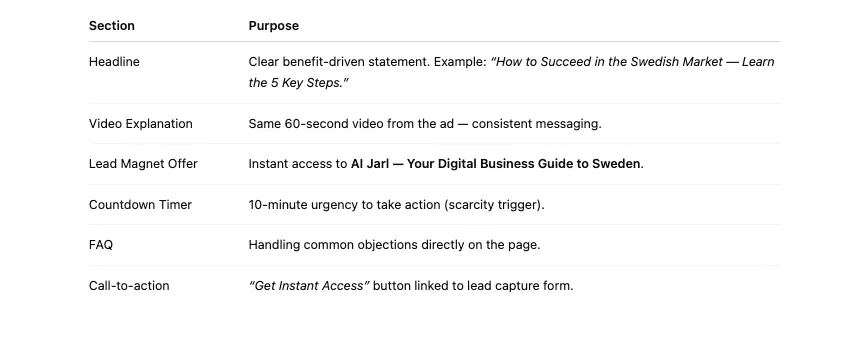
Getting a click on your ad is only half the battle – you need a landing page that converts that interest into action. All my Facebook ads pointed to a dedicated landing page (on my website) designed specifically for this campaign. I kept the page simple and very focused. Its job was to convince visitors to use my Ai Lead Magnet and sign up for my 10-week email course or AI Jarl access. Here’s how I structured it:
- Clear Headline & Offer: Right at the top, the page highlighted what the Lead Magnet is and the value it gives (e.g., “Free Guide: 5 Steps to Succeed in the Swedish Market”). Visitors shouldn’t have to guess what they’re getting.
- Reinforcement Video: I embedded the same 60-second video from the ad on the page. This consistency reinforces the message – if someone watched part of the video in the ad, they can finish it here or re-watch for details. It builds trust seeing my face/message again.
- Urgency with a Timer: I added a 10-minute countdown timer triggering when someone lands on the page. This wasn’t about being gimmicky; it provided a subtle push to take action now rather than later. It created a sense of scarcity/urgency to download the guide immediately (after all, the guide is free – the real goal was just to prompt fast action).
- FAQ Section: Below the main offer, I included a short FAQ addressing common questions or objections. For instance, “What is AI Jarl?” “Is the 10-week course really free?” “Who is this for?” – handling these objections on the page helps reduce hesitation.
- Lead Capture Form: Finally, the page had a simple form to enter name and email to use Ai Jarl (and thereby enroll in the free course and get a taste of AI Jarl). The call-to-action button was clear: “Get Instant Access”. I reiterated that they get the free guide + email lessons, so they know exactly what signing up means.
Every section of the page had a purpose, and that was to convert visitors into leads. There were no external links, no lengthy tangents – just a tight message matching the ad and a single action to take.
Step 5: Let the Campaign Run (Optimize & Learn)
Campaign Results: What I Achieved with €2/day
Once everything was set – the Facebook Page, the target audience, the video ad, and the landing page – I turned on the campaign and let it run. With just €2 per day, the results accumulated steadily:
- Consistent Traffic: The ad delivered roughly 100 website visitors per day on average. Over 90 days, this totaled about 9,000 visitors to my landing page – all people within my target profile.
- Affordable Leads: In total I spent just under €180 on Facebook ads to get those 9,000 visitors. That’s incredibly cheap for such highly targeted traffic (~€0.02 per visitor!). Every day I was basically “buying” 100 eyeballs from my exact niche for the price of a coffee.
- Insights for Targeting: By letting it run, I gathered data on which groups engaged the most. I could see, for example, that certain countries or industries clicked more, or that certain age groups had higher conversion rates. These insights are marketing gold – they told me where to focus and what messages might work best for future campaigns.
- Hands-Off Marketing: Importantly, this system ran in the background without me needing to micromanage it. Aside from occasional checks and tweaking the audience or ad if performance dipped, I didn’t have to spend much time. No agency or extra staff needed – technology handled the heavy lifting.
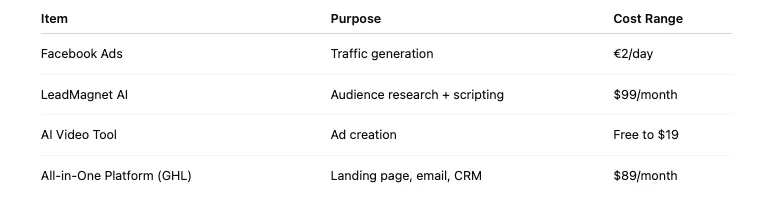
- Low-Budget, High-Impact: The table above shows the budget and tools I used for this entire campaign. As you can see, none of it is expensive. Facebook Ads themselves cost me only about €2/day. I used a few AI tools (like ChatGPT for copy and an AI video maker) either free or on low-cost plans. I built my landing page and email funnel using an all-in-one marketing platform (costing around $89/month) – this platform also handled my email course, lead capture, and CRM. The takeaway: you don’t need a big team or big budget to run a global campaign. With a few affordable tools and a clear strategy, a solo consultant can achieve a lot.
After 90 days, I had a solid flow of leads and even a couple of paying clients from this campaign. But equally valuable, I had data: I knew which ads worked best, which markets were most receptive, and how people moved through my funnel. That learning allowed me to refine my approach and increase the budget on what worked, pause what didn’t, and scale up intelligently.
Budget and Tools Overview
Why This Campaign Worked
Why This €2/Day Campaign Worked
It’s worth reflecting why this €2-a-day campaign was so effective, so you can apply these principles yourself:
- Specific, Niche Offer: My service (helping companies enter the Swedish market) is specific and aimed at a clear niche. The ad spoke directly to that niche’s pain points, making it immediately relevant to the right people. In marketing, if you try to appeal to everyone, you appeal to no one – niche focus wins.
- Leveraging AI & Automation: I used AI tools (like ChatGPT and Topview) to speed up everything from research to content creation. This saved time and ensured the messaging and targeting were sharp. Then I used automation (email sequences, etc.) to follow up. This tech amplified my one-person capacity into what felt like a whole team’s output.
- Simple, Human Message: Despite using high-tech tools, I kept the messaging simple and human. The ad and landing page addressed real frustrations and offered a clear solution in plain language – no jargon or fluff. Clarity and empathy in your copy will beat buzzwords and fancy design, every time.
- Playing to the Platform’s Strengths: I wasn’t trying to force a square peg in a round hole. I chose Facebook because it fit the campaign goal, and then I built content that fits Facebook’s environment (a catchy video for a scrolling feed, targeting options to narrow the audience). Use each marketing channel for what it’s best at instead of fighting against the grain.
- Follow-Through: Finally, the campaign didn’t end at the click. I had a well-thought-out after-click experience – the landing page and the email course – to nurture leads over time. Many folks who clicked weren’t ready to buy services immediately (which is fine), so giving them a free guide and more content keeps them engaged. By the time they’ve gone through my 10-week email series or interacted with AI Jarl, they’re far more educated and interested – and some reach out to work with me or subscribe further. The lesson: always have a next step for your prospects, so initial interest can turn into a relationship and eventually revenue.
Handling Global Admin & VAT: Use XOLO 👍
Simplify Your Global Admin with XOLO
So, you’ve built an entire marketing funnel and started getting international clients – great! But maybe you haven’t fully figured out the admin side of running a global consulting business (company registration, VAT-compliant invoicing, accounting, etc.). Don’t worry, I’ve got a concrete recommendation for this: XOLO.
XOLO is an online platform that takes care of the boring but crucial admin tasks for solopreneurs like us. It’s basically an all-in-one solution for running a one-person business globally. With XOLO, you can easily handle:
- Business formation
- Send invoices worldwide (with correct VAT handling)
- Manage your expenses, accounting, and tax reporting
All of this is managed through a simple dashboard. In other words, XOLO lets you legally run and bill your consulting services across borders without needing a full accounting department or fiddling with complex tax rules in each country.
I personally use XOLO to manage my international client billing. It saves me time and headaches so I can focus on serving my clients and marketing – not pushing paperwork.
If you’re planning to do business internationally (especially if you’re not set up with a full company in your home country yet), XOLO is the smartest way to launch and run your consulting business globally, legally, and hassle-free. Consider this your insider tip: you got your marketing sorted out, now get your operations sorted too with a tool like XOLO.
(Above is an affiliate link – I recommend XOLO because I truly use and love it, and I think you will too.)
Key Takeaways from Part 3
Key Takeaways
- Choose the right ad platform for your goals, not just what’s trendy. In my case, Facebook/Instagram delivered the best precision and value for a small budget – it connected me with my niche audience worldwide, for pennies.
- Use AI tools to sharpen your strategy and content. They can help define your audience, draft your messaging, and even create ads (like videos) faster. This gives you a competitive edge and saves time, especially as a solo entrepreneur.
- Simplicity wins. A clear message and structured funnel beat a complicated or flashy campaign. Make it obvious what you’re offering and what the user should do at each step. Remove distractions and friction from your landing page and ads.
- Spend small, learn fast, then scale up. You don’t need a big budget to start – €2 a day was enough to validate my approach and gather data. Once you see something working (a certain audience segment or ad creative), you can always invest more into that.
- Ensure your landing page does one job well: convert interest into action. Don’t treat clicks cheaply – once someone lands on your page, guide them to exactly what you promised (deliver value) and capture their info or get them to take the next step. Every element on that page should serve that single purpose.