
Nordic Assistant
PART 1:
Creating a Lead Magnet
How to Build a High-Converting, Authority-Driven Entry Point That Generates 6–7 Figure Clients
What if your next six-figure client could discover you while you sleep?
Imagine a digital version of yourself, an AI assistant that engages potential clients 24/7, answering their questions and showcasing your expertise without you lifting a finger. It might sound like a futuristic dream, but this is exactly how I scaled my consulting business – by creating a lead magnet so effective that it qualifies prospects on autopilot.
By the end of this module, you’ll understand how to build a high-converting lead magnet that works for you. More importantly, you’ll feel inspired to start building your own AI-powered assistant – a "digital you" that can attract and warm up leads even when you’re not around. Before we dive into the how-to, let’s set the stage on why this matters:
Did you know? Nearly 80% of marketers use lead magnets in their opt-in forms emailvendorselection.com – most often offering PDF guides or e-books. That means your prospects are used to seeing the same old “free guide” offers. As a consultant, this is your chance to stand out by offering something more interactive and valuable. Instead of yet another PDF download, you can wow your audience with an AI assistant that delivers real-time answers and personalized insights.
In this step-by-step guide, we’ll ensure you not only create an exceptional lead magnet, but also get excited to use Coachvox.ai to build and deploy it. Let’s jump in!
Step 1: Define Your Business Idea (Your Foundation)
Every great lead magnet starts with crystal clarity about your business. Before creating anything, you need to know exactly who you help, what you offer, and how your expertise stands out. This isn’t just about sharing knowledge – it’s about building a system that attracts, qualifies, and educates the right people so they’re primed to work with you.
Start with a quick self-assessment. Ask yourself:
- What do I do today that generates value for clients?
Example: “I freelance as a copywriter helping SaaS brands improve conversion rates.” - What kind of work do I want to do tomorrow?
Think about the services or projects you aspire to focus on. - Which client challenges do I enjoy solving the most?
The problems you’re passionate about tackling. - What proof or assets do I have already?
Consider your experience, past results, case studies, unique knowledge — anything that shows credibility.
Important: Your business idea is the foundation. Without a clear vision, you risk building a lead generation system that attracts the wrong people or offers the wrong solution. Take the time to nail this down before moving on.
Now, boil down your business idea into one simple, powerful sentence. A handy formula is:
“I help [target audience] achieve [desired result] through [your unique method/strength].”
Write yours down. If you can articulate your value in one sentence, you’re ready for the next step!
Step 2: Choose Your Niche (and Sub-Niche)
With your overarching idea defined, the next step is pinpointing exactly who you’re targeting. Avoid trying to appeal to everyone. The most successful consultants carve out a specific niche (and often a sub-niche) where they can shine without immense competition.
Think of this as finding your blue ocean – a space with high demand but low competition. In a crowded market, a narrow focus actually makes you more visible and memorable. Ask yourself:
- What market has clear demand but poor solutions?
Look for gaps where clients are underserved. - Which industries or roles are underserved or misunderstood?
These could be ripe for a specialist who “gets” them. - Where can I provide 10× more value than competitors?
Leverage your unique background to offer something no one else can.
Define both your niche and a sub-niche. For example, your niche might be “market entry consulting” and your sub-niche could be “B2B SaaS companies from Asia expanding into Sweden.” The niche defines the broad area of expertise, and the sub-niche identifies a very specific audience or use-case within that area. The more specific you are, the easier it is to become the go-to expert for that group.
Remember: It’s better to be the expert in a smaller niche than a generalist in a crowded market. A tightly defined audience makes your lead magnet insanely targeted and effective.
Step 3: Leverage AI to Discover Your Edge
Sharpen Your Competitive Edge with AI
Now that you know what you offer and whom you serve, it’s time to sharpen your competitive edge. One of the fastest ways to do this is by brainstorming with AI. You can use tools like ChatGPT (or even your own future Coachvox AI assistant) to gain insights into your business idea, strengths, and market.
Try using AI prompts to explore the following areas:
Uncover Your Unfair Advantage
"I’m thinking of starting a business that [describe what this business does] and I want to understand my unique strengths in making it a success. I have experience in [describe your experience] and expertise in [describe your expertise]. I have access to people who [describe your network]. Can you give me the reasons why this will and won’t be a success based on my specific situation?"
Profile Your Perfect Customer
"Now that you know what business I want to start, help me choose the best niche and sub-niche by proposing 5 clearly different customer segments that would benefit the most from this business idea.
For each of the 5 niches and sub-niches:
- Describe the ideal customer in that segment (demographics, role, behavior, industry, etc).
- List their top 3 problems or frustrations that my business could solve — ranked by how urgent or important they are.
- Explain what solutions, tools or services they currently use (or try to use), and where those might fall short.
- Indicate what emotional triggers or business needs would motivate them to try something new like my solution.
Finish by telling me which niche/sub-niche is the most promising based on my experience and the business I want to build."
Assess Market Demand
"Can you give me 3 main reasons why someone would want to buy my product — based specifically [on the most promising niche/sub-niche you previously identified?]
Next, estimate how many people in [location, if applicable] could be in my target audience, and tell me the size of this market and its likely growth over the next five years.
Please also include any adjacent markets I could explore."
Take notes on the insights you get. This AI-assisted research will not only boost your confidence that you’re on the right track, but also arm you with messaging points for your lead magnet. (You might even reuse some of the phrasing the AI gives you when you train your own assistant!)
Step 4: Build Your Lead Magnet – Your 24/7 Digital Asset
Armed with clarity on your value and audience, it’s time to create the lead magnet itself – the asset that will work while you sleep. In traditional terms, a “lead magnet” could be a PDF guide, checklist, or webinar. But here, we’re going to take it a step further and build an interactive lead magnet that scales your expertise.
Your lead magnet – whatever format it takes – should meet a few key criteria to be high-converting:
- Directly answer key questions your ideal clients are asking. It must scratch the itch your target clients feel right now.
- Be available on-demand, 24/7. Whether it’s hosted on your website, emailed out, or (in our case) accessible through a chat interface, it should be there whenever a prospect is ready to engage.
- Help the prospect make a better decision. By the end of consuming your lead magnet, the reader/viewer should feel more informed, capable, or confident. Ideally, it highlights the path to solving their problem (and gently positions your services as the next logical step).
Now, instead of a static PDF or video, imagine a lead magnet that checks all those boxes and feels personal to each user. This is where your AI assistant comes in.
I chose to build an AI assistant as my lead magnet using Coachvox.ai – essentially a digital version of myself that prospects can consult. I trained it with over 1,000 prompts and Q&As from real consulting conversations I’ve had. The result? My AI assistant speaks multiple languages, works 24/7, and lets potential clients tap into my knowledge base anytime, anywhere. They can literally have a conversation with “me” on my website before we ever even schedule a call.
You can do the same. Think about it: you’ve accumulated a wealth of insights, frameworks, stories, and advice in your field. By training an AI on this knowledge, you create an interactive tool that delivers personalized value to each prospect. It’s like having an assistant coach or consultant who always knows the right answer (because it’s using your answers). Make sure to infuse it with your personality and tailor it to the specific needs of your niche, so it feels like a helpful mentor, not a generic chatbot.
Getting started is easier than you might think. If you haven’t already, go ahead and sign up for a free Coachvox.ai trial and start uploading some of your insights. (Coachvox offers a 14-day free trial, with plans at $99/month after – plenty of time to prototype your AI lead magnet.) You can begin by feeding it a handful of frequently asked questions from your clients and your well-crafted answers. In just an hour or two, you could have the foundation of your always-on, expert assistant ready to go.
👉 Try Coachvox AI free for 14 days and watch your own digital assistant take shape. There’s nothing quite like seeing your knowledge come alive in a conversation – and your prospects will love it.
(Go on, you can open it in a new tab and give it a spin – see how an AI version of you might handle a common client question!)
Step 5: Make It Personal and Authentic
Make Your Lead Magnet Stand Out
Finally, remember that no matter what format your lead magnet takes, if it looks and sounds like everyone else’s, it will be ignored. The whole point of this asset is to showcase you – your expertise, your approach, and your personality. So don’t shy away from adding personal touches and real stories.
- Include anecdotes from your own journey, share a quick case study of a client you helped, or reference something in your industry culture that your audience would relate to.
- These specifics make your content memorable and build trust.
- Infuse personality into your AI assistant lead magnet by training it with your personal stories, humor, and unique style.
- Ensure consistency between your lead magnet and your consulting style to build credibility.
- Your lead magnet should filter the right prospects by resonating strongly with your ideal clients.
(Curious how I built my own AI lead magnet and what it looks like in action? I’ve recorded a short video walkthrough – feel free to watch and get inspiration when you have a moment.)
Whether you build an AI assistant or download your guide this week, your effort is roughly the same – but the impact can be exponential.
Why This Approach Works
Why an AI-Based Lead Magnet Works
You might be wondering, does an AI-based lead magnet really live up to the hype? Here’s why this approach is so powerful for consultants and freelancers:
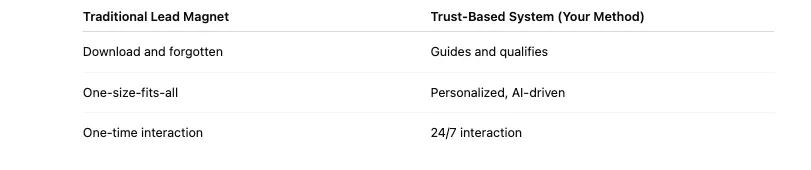
- It builds trust before the sale: By the time a prospect speaks with you, they’ve already experienced your expertise and value firsthand through your lead magnet. The relationship starts warm, not cold.
- It filters and qualifies your leads: A robust lead magnet (especially an interactive one) will address common questions and scenarios, meaning those who reach out afterward are likely serious and more educated. Tire-kickers will either get what they need or realize on their own if it’s not a fit.
- It educates your audience and positions you as the guide: You’re not just pitching your services – you’re helping people understand their challenges and possibilities. This positions you as a trusted advisor, not a salesperson. When they’re ready for more, who will they call? The expert who already helped them (you!).
- It scales your expertise without consuming more of your time: Whether one person or 1,000 people interact with your AI assistant (or download your guide) this week, your effort is roughly the same. You’ve built an asset once that can serve many. That’s true scalability, crucial for solo consultants who can’t multiply their hours.
Key Takeaways from Part 1
Let’s recap the most important points from this module:
- Lay a solid foundation first: Define your value proposition, niche, and message before building a lead magnet. If you skip this, you might attract the wrong audience or promise the wrong thing.
- Find your “blue ocean”: Focus on a niche where your expertise is unmatched and you’re not battling a thousand competitors. It’s easier to stand out in a smaller pond.
- Work smarter with AI: Don’t reinvent the wheel – use prompts and AI tools to organize your knowledge and uncover insights quickly. This will save time and make your lead magnet creation easier.
- Deliver real value (and better buyers): A great Lead Magnet doesn’t just collect emails; it actually helps prospects and primes them to become ideal clients. The more value you give, the more qualified and eager your leads will be.
- Make it interactive and available 24/7: An always-on resource (like your AI assistant) can engage people anytime, anywhere. And when it’s personalized and interactive, it keeps prospects engaged longer than a static PDF would.
Ready for Part 2? (Automation Awaits)
Congratulations – you’ve laid the groundwork for a powerful lead magnet and even peeked into how AI can amplify your reach. By now, you should have a clear idea of your target niche and perhaps you’ve even started building your very own AI assistant to serve as your lead magnet.
Next up is Part 2: Automation. In the second module of this series, we’ll dive into how to automate your lead flow, nurturing, and booking processes, so that much of your client acquisition runs on autopilot (yes, even more autopilot than we achieved in Part 1!). You’ll learn how to let technology do the heavy lifting when it comes to following up with leads and scheduling calls, so you can save time and focus on what you do best.
But before you head over to Part 2, make sure to take action on Part 1. The best time to start building your interactive lead magnet is now. If you haven’t already, try Coachvox.ai for free and begin training your digital self. Even a small first step – like uploading a few Q&As or drafting that one-sentence value statement – will put you on the path to landing those 6–7 figure clients.
Ready to turn your expertise into a client magnet? Your AI-assisted journey is just beginning.